Monday, August 18, 2014
Preview: NYFF 52 MAIN SLATE - 2014 NEW YORK FILM FESTIVAL
THE FILM SOCIETY OF LINCOLN CENTER
52ND NEW YORK FILM FESTIVAL 2014
NYFF 52
SEPTEMBER 26 - OCTOBER 12
MAIN SLATE
30 features including new films by
Lisandro Alonso, Asia Argento, Olivier Assayas,
Nick Broomfield, Pedro Costa, David Cronenberg,
Jean-Pierre & Luc Dardenne, Abel Ferrara, Jean-Luc Godard,
Hong Sang-soo, Mike Leigh, Mia Hansen-Løve,
Bennett Miller, Oren Moverman, Alex Ross Perry,
Alain Resnais, Alice Rohrwacher,Josh & Benny Safdie
&&&…
30 films comprise the Main Slate official selections of the 52nd New York Film Festival (September 26 – October 12).
Opening Night Gala Selection
GONE GIRL- Director: David Fincher
Centerpiece Gala Selection
INHERENT VICE - Director: Paul Thomas Anderson
Closing Night Gala Selection
BIRDMAN OR THE UNEXPECTED VIRTUE OF IGNORANCE - Director: Alejandro G. Iñárritu

GONE GIRL
Nick (Ben Affleck, left) is questioned about the disappearance of his wife Amy,
by Detectives Boney (Kim Dickens, far right) and Gilpin (Patrick Fugit, in dark shirt),
as Nick¹s in-laws Marybeth and Rand Elliott (Lisa Barnes, David Clennon) look on.
NYFF 2014
Photo credit: Merrick Morton.
This year’s films are an eclectic (mostly USA-Euro centric) bunch, the largest number coming from the USA, then many from France, some from elsewhere in Europe, three films from Argentina, one from Korea, with one co-production from Timbuktu, France and Mauritania (in Arabic, Bambara, French, English, Songhay, and Tamasheq). There are no films from Russia, China, Brazil, Japan, or India.

TIMBUKTU
NYFF 2014
Photo Courtesy Cohen Media Group
Most of the films are from well-established filmmakers with an international reputation. (It’s hard to break into the NYFF.)
There is no easily discernable theme to this year’s festival – neither love, nor politics, nor breakout trends-and-tech seem to be over-represented. There is some emphasis on the artistic creative process itself. Or perhaps “old-fashioned reputation” is this year’s theme. Only Godard – the most established of all film revolutionaries – has a new-tech venture with a 3-D film. And Alain Resnais’ first (1959) feature, HIROSHIMA MON AMOUR, which was a cold-war nuclear anthem, has been restored and will be paired in the Revivals section, to complement Resnais’ final film, LIFE OF RILEY, in the Main Slate.
The NYFF is a non-competitive festival that always includes some of the most distinguished films from festivals earlier in the year around the world.
Award winners from other festivals presented for the first time to New York audiences include four from this year’s Cannes Film Festival:
• Alice Rohrwacher’s THE WONDERS, the winner of the 2014 Grand Prix Award;
• Bennett Miller’s FOXCATCHER, for which he was named Best Director,
• David Cronenberg’s MAPS TO THE STARS, for which Julianne Moore won the prize for Best Actress, and
• Mike Leigh’s MR. TURNER, for which Timothy Spall received the Best Actor Award for his performance as the painter J.M.W. Turner.
Additional award winners are
• Damien Chazelle’s WHIPLASH, which won the U.S. Grand Jury Prize and the Audience Award at this year’s Sundance Film Festival, and
• LIFE OF RILEY, the final feature from the late Alain Resnais, which took home the Berlin Film Festival’s Silver Bear Alfred Bauer Prize. The 4K restored version of Resnais’ first feature, HIROSHIMA MON AMOUR (1959), was previously announced as part of the Revivals selection at this year’s NYFF.
Jean-Luc Godard’s GOODBYE TO LANGUAGE, his first feature in 3-D, will screen at NYFF in the wake of the comprehensive retrospective of the filmmaking legend’s work that was a highlight of last year’s festival.
Other notables among the many filmmakers returning to NYFF with new works are
• Olivier Assayas with CLOUDS OF SILS MARIA, which stars Juliette Binoche as an actress preparing for a new role and Kristen Stewart as her assistant;
• Pedro Costa with HORSE MONEY, a moving look at the life of Cape Verdean Ventura, who has worked with Costa on his last few films;
• Jean-Pierre & Luc Dardenne with TWO DAYS, ONE NIGHT, which stars Marion Cotillard as a woman desperately trying to save her job; and
• Abel Ferrara, with his biographical film PASOLINI, starring Willem Dafoe as the controversial filmmaker/poet/novelist.
NYFF’s 2014 Filmmaker in Residence Lisandro Alonso’s latest film, JAUJA, which stars Viggo Mortensen as an Argentinian officer in the 1870s searching for his missing daughter, will be a highlight, as will the North American premiere of French actor Mathieu Amalric’s heated dramatization of Georges Simenon’s novel THE BLUE ROOM, about a love triangle coming to a dangerous conclusion.

THE BLUE ROOM
NYFF 2014
Actress Asia Argento also puts on the director’s hat once again with her new autobiographical film, MISUNDERSTOOD, about a pre-teen girl all but ignored by her self-absorbed superstar parents in 1980s Rome.
The city of New York takes center stage via the works of local filmmakers Alex Ross Perry, Oren Moverman, and Josh & Benny Safdie.
• Perry’s LISTEN UP PHILIP stars Jason Schwartzman as an insufferable young literary star taken under the wing of an older literary lion played by Jonathan Pryce.
• Moverman’s TIME OUT OF MIND features a remarkable performance by Richard Gere as a man who finds himself out on the streets.
• The Safdie Brothers’ HEAVEN KNOWS WHAT places us in the world of two heroin-addicted young lovers as they struggle to live and find their next fix.
The Festival also features a largess of performances by distinguished actors, from young rising stars like Chloe Grace Moretz, to young international stars like Hannah Herzsprung and Alba Rohrwacher, to major stars like Marianne Moore, Richard Gere, Joaquin Phoenix, Steve Carell, Mathieu Amalric, Juliette Binoche, Ben Affleck, and many more. (Performers are highlighted in red below.)
Although the exact schedule has not been announced, it is likely that many of the actors and directors will accompany their films to the NYFF and participate in a live Q&A session with the audience.
The NYFF also includes special events, documentary sections, and filmmaker conversations and panels, as well as NYFF’s Projections and the full Convergence programs, to be detailed later.
Tickets for the upcoming New York Film Festival range in price from $15 & $25 for most screenings to $50 & $100 for Gala evenings. Film Society members receive a discount on tickets as well as the benefit of a pre-sale opportunity.
For NYFF Free events: Starting one hour before the scheduled time of the event, complimentary tickets will be distributed from the box office corresponding to the event's venue. Limit one ticket per person, on a space available basis. Please note that the line for tickets may form in advance of the time of distribution
An updated NYFF App will soon be available on iOS and Android.
For more information, visit:
52nd NEW YORK FILM FESTIVAL
Films & Descriptions
(Note: DCP = Digital Cinema Package)
Opening Night – World Premiere
Gone Girl
David Fincher, USA, 2014, DCP, 150m
David Fincher’s film version of Gillian Flynn’s phenomenally successful best seller (adapted by the author) is one wild cinematic ride, a perfectly cast and intensely compressed portrait of a recession-era marriage contained within a devastating depiction of celebrity/media culture, shifting gears as smoothly as a Maserati 250F. Ben Affleck is Nick Dunne, whose wife Amy (Rosamund Pike) goes missing on the day of their fifth anniversary. Neil Patrick Harris is Amy’s old boyfriend Desi, Carrie Coon (who played Honey in Tracy Letts’s acclaimed production of Who’s Afraid of Virginia Woolf?) is Nick’s sister Margo, Kim Dickens (Treme, Friday Night Lights) is Detective Rhonda Boney, and Tyler Perry is Nick’s superstar lawyer Tanner Bolt. At once a grand panoramic vision of middle America, a uniquely disturbing exploration of the fault lines in a marriage, and a comedy that starts black and keeps getting blacker, Gone Girl is a great work of popular art by a great artist. A 20th Century Fox and Regency Enterprises release.
Centerpiece – World Premiere
Inherent Vice
Paul Thomas Anderson, USA, 2014, 148m
Paul Thomas Anderson’s wild and entrancing new movie, the very first adaptation of a Thomas Pynchon novel, is a cinematic time machine, placing the viewer deep within the world of the paranoid, hazy L.A. dope culture of the early ’70s. It’s not just the look (which is ineffably right, from the mutton chops and the peasant dresses to the battered screen doors and the neon glow), it’s the feel, the rhythm of hanging out, of talking yourself into a state of shivering ecstasy or fear or something in between. Joaquin Phoenix goes all the way for Anderson (just as he did in The Master) playing Doc Sportello, the private investigator searching for his ex-girlfriend Shasta (Katherine Waterston, a revelation), menaced at every turn by Josh Brolin as the telegenic police detective “Bigfoot” Bjornsen. Among the other members of Anderson’s mind-boggling cast are Reese Witherspoon, Benicio Del Toro, Martin Short, Owen Wilson, and Jena Malone. A trip, and a great American film by a great American filmmaker. A Warner Bros. Pictures release.
Closing Night – New York Premiere
Birdman or The Unexpected Virtue of Ignorance
Alejandro G. Iñárritu, USA, 2014, DCP, 119m
In Alejandro G. Iñárritu’s big, bold, and beautifully brash new movie, one-time action hero Riggan Thomson (a jaw-dropping Michael Keaton), in an effort to be taken seriously as an artist, is staging his own adaptation of Raymond Carver’s What We Talk About When We Talk About Love. As Thomson tries to get his perilous undertaking in shape for the opening, he must contend with a scene-hogging narcissist (Edward Norton), a vulnerable actress (Naomi Watts), and an unhinged girlfriend (Andrea Riseborough) for co-stars; a resentful daughter (Emma Stone); a manager who’s about to come undone (Zach Galifianakis)... and his ego, the inner demon of the superhero that made him famous, Birdman. Iñárritu’s camera magically prowls, careens, and soars in and around the theater, yet remains alive to the most precious subtleties and surprises between his formidable actors. Birdman or The Unexpected Virtue of Ignorance is an extravagant dream of a movie, alternately hilarious and terrifying, powered by a deep love of acting, theater, and Broadway—a real New York experience. A Fox Searchlight Pictures and New Regency release.

Edward Norton and Emma Stone
BIRDMAN OR THE UNEXPECTED VIRTUE OF IGNORANCE
NYFF 2014
Photo Courtesy Fox Searchlight Pictures
North American Premiere
Beloved Sisters / Die geliebten Schwestern
Dominik Graf, Germany/Austria, 2014, DCP, 170m
German and French with English subtitles
Romantic sentiment runs high but aristocratic decorum holds sway in this beautiful and thoroughly modern rendering of the real-life 18th-century love triangle involving German poet Friedrich Schiller (Florian Stetter) and two sisters of noble birth, Charlotte (Henriette Confurius) and Caroline (Hannah Herzsprung), whose strikingly intense relationship and profound mutual devotion verge on symbiosis. As Schiller’s star rises in the philosophical-literary world of Weimar Classicism, with Charlotte at his side, the married Caroline chooses to stay close by—with dramatic consequences. Sisterhood is finally the most passionate and wrenching form of love in the aptly titled Beloved Sisters, and the deeply felt performances of Confurius and Herzsprung are hard to forget. Meanwhile, there’s a fresh, bracingly contemporary sense of energy, a relaxed pace and a down-to-earth directness to director Dominik Graf’s unfussy re-creation of ultra-formal 18th-century town-and-country life. A Music Box Films release.
North American Premiere
The Blue Room / La chambre bleue
Mathieu Amalric, France, 2014, DCP, 76m
French with English subtitles
A perfectly twisted, timeless noir, Mathieu Amalric’s adaptation of Georges Simenon’s domestic crime novel also tips its hat to Alfred Hitchcock/Patricia Highsmith’s Strangers on a Train. A country hotel’s blue room is the scene of erotic rapture, but the adulterous man (Amalric) and woman (a boldly sexual Stéphanie Cléau, co-author of the script with Amalric) who meet there have different visions of their future. She is more obsessed than he, and his misunderstanding of the madness in her desire will destroy him and all he holds dear. Amalric’s direction is brutally spare, as is his performance of a man caught in a vise—a situation of his own making. The classic aspect ratio (1:33) and Grégoire Hetzel’s turbulent, insistent score heighten the sense of entrapment. Léa Drucker as the deceived wife and Cléau as the desperate mistress make strong impressions, but Amalric, who has the most eloquent eyes in contemporary cinema and uses them here to convey lust, guilt, bewilderment, and the dawning realization that he is a pawn in a malignant game, is unforgettable. A Sundance Selects release.
U.S. Premiere
Clouds of Sils Maria
Olivier Assayas, Switzerland/Germany/France, 2014, DCP, 124m
English and French with English subtitles
Maria Enders (Juliette Binoche) is a middle-aged actress who soared to stardom in her twenties in a play called Maloja Snake, in which she created the role of a ruthless young woman named Sigrid who engages in a power game with her older boss. Now an established international actress, Maria is considering the role of the older woman in a heavily promoted revival, with an infamous young superstar (Chloë Grace Moretz) as Sigrid. Maria and her savvy personal assistant (Kristen Stewart) prepare for the production at a secluded spot in the Swiss Alps, in a series of stunning scenes that are the beating heart of Olivier Assayas’s brilliant new film. What begins as a chronicle of an actress going through the paces of celebrity culture (fashion shoots, official dinners, interviews, Internet rumors) gradually develops into something more powerfully mysterious: a close meditation on time and how one comes to terms with its passage. An IFC Films release.
U.S. Premiere
Eden
Mia Hansen-Løve, France, 2014, DCP, 131m
Mia Hansen-Løve’s fourth feature is a rare achievement: an epically scaled work built on the purely ephemeral, breathlessly floating along on currents of feeling. Eden is based on the experiences of Hansen-Løve’s brother (and co-writer) Sven, who was one of the pioneering DJs of the French rave scene in the early 1990s. Paul (Félix de Givry) and his friends, including Guy-Manuel de Homem-Christo and Thomas Bangalter (otherwise known as Daft Punk), see visions of ecstasy in garage music—as their raves become more and more popular, they experience a grand democracy of pure bliss extending into infinity, only to dematerialize on contact with changing times and the demands of everyday life. Hansen-Løve’s film plays in the mind as a swirl of beautiful faces and bodies, impulsive movements, rushes of cascading light and color (she worked with a great cameraman, Denis Lenoir), and music, music, and more music. Eden is a film that moves with the heartbeat of youth, always one thought or emotion ahead of itself.
New York Premiere
Foxcatcher
Bennett Miller, USA, 2014, DCP, 134m
Bennett Miller’s quietly intense and meticulously crafted new film deals with the tragic story of billionaire John E. du Pont and the brothers and championship wrestlers Dave and Mark Schultz recruited by du Pont to create a national wrestling team on his family’s sprawling property in Pennsylvania. Miller builds his film detail by detail, and he takes us deep into the rarefied world of the delusional du Pont, a particularly exotic specimen of ensconced all-American old money and privilege. Miller’s film is a powerfully physical experience, and the simmering conflicts between his characters are expressed in their stances, their stillnesses, their physiques, and, most of all, their moves in the wrestling arena. At the core is a trio of perfectly meshed and absolutely stunning performances from Mark Ruffalo as Dave, Channing Tatum as Mark, and an almost unrecognizable Steve Carell as the fatally dissociated du Pont. Foxcatcher offers us a vivid portrait of a side of American life in the ’80s that has never been touched in movies. A Sony Pictures Classics release.
New York Premiere
Goodbye to Language / Adieu au langage
Jean-Luc Godard, France, 2014, DCP, 70m
French with English subtitles
The 43rd feature by Jean-Luc Godard (and the only film at the 2014 Cannes Film Festival to get a round of applause mid-screening), Goodbye to Language alights on doubt and despair with the greatest freedom and joy. At 83, Godard works as a truly independent filmmaker, unencumbered by all concerns beyond the immediate: to create a work that embodies his own state of being in relation to time, light, color, the problem of living and speaking with others, and, of course, cinema itself. The artist’s beloved dog Roxy is the de facto “star” of this film, which is as impossible to summarize as a poem by Wallace Stevens or a Messiaen quartet. Goodbye to Language was shot, and can only be truly seen and experienced, in 3-D, which Godard has put to wondrous use. The temptation may be strong to see this film as a farewell, but this remarkable artist is already hard at work on a new project. A Kino Lorber release.
U.S. Premiere
Heaven Knows What
Josh & Benny Safdie, USA, 2014, DCP, 93m
Harley (Arielle Holmes) is madly in love with Ilya (Caleb Landry Jones). She’s sure he loves her just as much, if only he could express it. Both of them are heroin addicts, kids who pretend to be heavy-metal rockers but spend their time scuffling, arguing, and preying on each other as they wander around New York looking for a fix and the chump change to pay for it. The script, based on a Holmes’s memoir and written by the Safdies with Ronald Bronstein, is a miracle of economy. Sean Price Williams’s cinematography expresses the clouded vision of kids who can’t imagine how invisible they are to the New Yorkers who take their homes and jobs for granted. And the Safdie Brothers, in their toughest and richest movie, direct a cast composed largely of first-time actors so that they disappear into their characters, horrify us, and break our hearts.
U.S. Premiere
Hill of Freedom / Jayuui Eondeok
Hong Sang-soo, South Korea, 2014, DCP, 66m
Korean and English with English subtitles
Kwon (Seo Young-hwa) returns to Seoul from a restorative stay in the mountains. She is given a packet of letters left by Mori (Ryo Kase), who has come back from Japan to propose to her. As she walks down a flight of stairs, Kwon drops and scatters the letters, all of which are undated. When she reads them, she has to make sense of the chronology… and so do we. Hong Sang-soo’s daring new film, alternately funny and haunting, is a series of disordered scenes based on the letters, echoing the cultural dislocation felt by Mori as he tries to make himself understood in halting English. At what point did he drink himself into a lonely stupor? Did he sleep with the waitress from the Hill of Freedom café (Moon So-ri) before or after he despaired of seeing Kwon again? Sixteen films into a three-decade career, Hong has achieved a rare simplicity in his storytelling, allowing for an ever-increasing psychological richness and complexity.
U.S. Premiere
Horse Money / Cavalo Dinheiro
Pedro Costa, Portugal, 2014, DCP, 103m
Portuguese and Creole with English subtitles
Since the late ’90s, Pedro Costa has devoted himself to the task of doing justice to the lives and tragedies and dreams of the Cape Verdean immigrants who once populated the now-demolished neighborhood of Fontainhas. Costa works with a minimal crew and at ground level, patiently building a unique cinematographic language alongside the men and women he has befriended. Where does his astonishing new Horse Money “take place”? In the soul-space of Ventura, who has been at the center of Costa’s last few shorts and his 2006 feature Colossal Youth. It is now, a numbing and timeless present of hospital stays, bureaucratic questioning, and wandering through remembered spaces… and it is then, the mid ’70s and the time of the Carnation Revolution, when Ventura got into a knife fight with his friend Joaquim. A self-reckoning, a moving memorialization of lives in danger of being forgotten, and a great and piercingly beautiful work of cinema.
U.S. Premiere
Jauja
Lisandro Alonso, Argentina/Denmark/France/Mexico/USA/Germany/Brazil, 2014, DCP, 108m
Danish and Spanish with English subtitles
A work of tremendous beauty and a source of continual surprise, Alonso’s first film since 2008’s Liverpool is also his first period piece (set during the Argentinian army’s Conquest of the Desert in the 1870s), his first film with international stars (led by Viggo Mortensen), and his first screenplay with a co-writer (poet and novelist Fabián Casas). But the emphasis, as in all his work, is on bodies in landscapes. Danish military engineer Gunnar Dinesen (Mortensen, in a Technicolor-bright cavalry uniform) traverses a visually stunning variety of Patagonian shrub, rock, grass, and desert on horseback and on foot in search of his teenage daughter (Viilbjørk Agger Malling), who has eloped with a new love. Alonso’s style reaches new heights of sensory attentiveness and physicality, driving the action toward a thrilling conclusion that transcends the limits of cinematic time and space.
New York Premiere
Life of Riley / Aimer, boire et chanter
Alain Resnais, France, 2014, DCP, 108m
French with English subtitles
Adapted from Alan Ayckbourn’s Relatively Speaking, Life of Riley, the final work by Alain Resnais, is the story of three couples in the English countryside who learn that their close mutual friend is terminally ill. Yet the story is only half the movie, a giddily unsettling meditation on mortality and the strange sensation of simply being alive and going on, feeling by feeling, action by action. The swift, fleeting encounters between various combinations of characters (played by Resnais regulars André Dussollier and Sabine Azéma—the director’s wife—along with Michel Vuillermoz, Hippolyte Girardot, Sandrine Kiberlain, and Caroline Silhol) take place on extremely stylized sets, and they are punctuated with close-ups set against comic-strip grids, and broken up by images of the real English countryside. Funny but haunting, Life of Riley is a moving, graceful, and surprisingly affirmative farewell to life from a truly great artist. (Note: The literal translation of the French title is "To love, to drink and to sing".) A Kino Lorber release.
New York Premiere
Listen Up Philip
Alex Ross Perry, USA, 2014, DCP, 108m
Alex Ross Perry’s third feature heralds the arrival of a bold new voice in American movies. Even more than in his critically lauded The Color Wheel, Perry draws on literary models (mainly Philip Roth and William Gaddis) to achieve a brazen mixture of bitter humor and unexpected pathos. In this sly, very funny portrait of artistic egomania, Jason Schwartzman stars as Philip Lewis Friedman, a precocious literary star anticipating the publication of his second novel. Philip is a caustic narcissist, but the film, shot with tremendous agility on Super-16mm by Sean Price Williams, leaves his orbit frequently, lingering on the perspectives of his long-suffering photographer girlfriend, Ashley, (Elisabeth Moss) and his hero, the Roth-like literary lion Ike Zimmerman (Jonathan Pryce), who himself considers Philip a major talent. A film about callow ambition, Listen Up Philip is itself remarkably poised, a knowing, rueful account of how pain and insecurity transfigure themselves as anger but also as art. A Tribeca Film release.

MAPS TO THE STARS
NYFF 2014
U.S. Premiere
Maps to the Stars
David Cronenberg, Canada/Germany, 2014, DCP, 111m
David Cronenberg takes Bruce Wagner’s script—a pitch-black Hollywood satire—chills it down, and gives it a near-tragic spin. The terrible loneliness of narcissism afflicts every character from the fading star Havana (Julianne Moore, who won the Best Actress Award at Cannes for her nervy performance) to the available-for-anything chauffeur (Robert Pattinson) to the entire Weiss family, played by John Cusack, Olivia Williams, Evan Bird, and Mia Wasikowska. The last two are brother and sister, damaged beyond repair and fated to repeat the perverse union of their parents. And yet, in their murderous rages, they have the purity of avenging angels, taking revenge on a culture that needs to be put out of its misery—or so it must seem to them. Cronenberg’s visual strategy physically isolates the characters from one another, so that their occasional violent connections pack a double whammy. An eOne Films release.
North American Premiere
Misunderstood / Incompresa
Asia Argento, Italy/France, 2014, DCP, 110m
Italian, French, and English with English subtitles
The imaginative life of a preteen girl in Rome in the 1980s is depicted with love and humor by Asia Argento, who grew up in the same place and time under similar showbiz circumstances. All but ignored by her divorced, narcissistic parents and tormented by her more conventional and manipulative siblings, Aria (a marvelous Giulia Salerno) shuttles between the well-appointed digs of her singer mother (Charlotte Gainsbourg) and actor father (Gabriel Garko), carrying her only companion, a large cat who is more affectionate and comfortable in his own skin than any of the humans in her life. A precociously gifted writer, Aria elaborates her cat-accompanied walks into the sometimes life-threatening adventures that mix with mundane actualities. As a projection of young female subjectivity, Misunderstood is ingenious, direct, and utterly real.
New York Premiere
Mr. Turner
Mike Leigh, UK, 2014, DCP, 149m
Mike Leigh’s Mr. Turner is certainly a portrait of a great artist and his time, but it is also a film about the human problem of… others. Timothy Spall’s grunting, unkempt J.M.W. Turner is always either working or thinking about working. During the better part of his interactions with patrons, peers, and even his own children, he punches the clock and makes perfunctory conversation, while his mind is clearly on the inhuman realm of the luminous. After the death of his beloved father (Paul Jesson), Turner creates a way station of domestic comfort with a cheerful widow (Marion Bailey), and he maintains his artistic base at his family home, kept in working order by the undemonstrative and ever-compliant Hannah (Dorothy Atkinson). But his stays in both houses are only rest periods between endless and sometimes punishing journeys in search of a closer and closer vision of light. A rich, funny, moving, and extremely clear-eyed film about art and its creation. A Sony Pictures Classics release.
U.S. Premiere
Pasolini
Abel Ferrara, France/Belgium/Italy, DCP, 87m
Italian, English, and French with English subtitles
Pier Paolo Pasolini—filmmaker/poet/novelist, Christian, Communist, permanent legal defendant, and self-proclaimed “inconvenient guest” of modern society—was an immense figure. Abel Ferrara’s new film compresses the many contradictory aspects of his subject’s life and work into a distilled, prismatic portrait. We are with Pasolini during the last hours of his life, as he talks with his beloved family and friends, writes, gives a brutally honest interview, shares a meal with Ninetto Davoli (Riccardo Scamarcio), and cruises for the roughest rough trade in his gun-metal gray Alfa Romeo. Over the course of the action, Pasolini’s life and his art (represented by scenes from his films, his novel-in-progress Petrolio, and his projected film Porno-Teo-Kolossal) are constantly refracted and intermingled to the point where they become one. A thoughtful, attentive, and extremely frank meditation on a man who continues to cast a very long shadow, featuring a brilliant performance by Willem Dafoe in the title role.
U.S. Premiere
The Princess of France / La Princesa de Francia
Matías Piñeiro, Argentina, 2014, DCP, 70m
Spanish and Italian with English subtitles
As in his critical hit Viola (2013), Matías Piñeiro doesn’t transplant Shakespeare to the present day so much as summon the spirit of his polymorphous comedies. Víctor (Julián Larquier Tellarini) returns to Buenos Aires after his father’s death and a spell in Mexico to prepare a radio production of Love’s Labour’s Lost. Reuniting with his repertory, he finds himself sorting out complicated entanglements with girlfriend Paula (Agustina Muñoz), sometime lover Ana (María Villar), and departed actress Natalia (Romina Paula), as well as his muddled relations with the constellation of friends involved with the project. As the film tracks the group’s criss-crossing movements and interactions, their lives become increasingly enmeshed with the fiction they’re reworking, potential outcomes multiply, and reality itself seems subject to transformation. An intimate, modestly scaled work that takes characters and viewers alike into dizzying realms of possibility, The Princess of France is the most ambitious film yet from one of world cinema’s brightest young talents, a cumulatively thrilling experience. A Cinema Guild release.
North American Premiere
Saint Laurent
Bertrand Bonello, France, 2014, DCP, 146m
French with English subtitles
Running counter to the current strain of wan, mechanical biopics, Bertrand Bonello’s Saint Laurent toys deliriously with the genre’s rules and limitations. Focusing on a dark, hedonistic, wildly creative decade (from 1967 to ’77) in Yves Saint Laurent’s life and career, Bonello considers the couturier (convincingly embodied by Gaspard Ulliel and later by Visconti stalwart Helmut Berger) as a myth, a brand, an avatar of his era. Bonello’s star-studded supporting cast (including Louis Garrel, Léa Seydoux, Jérémie Renier, and Valeria Bruni Tedeschi) serves as first-rate human mise en scène amid a kaleidoscopic torrent of lavish excess, retrospectively pieced together with a Proustian form of fast-and-loose association. As much as his subject and the gravitational pull he exerts in the hothouse environments of atelier and nightclub, Bonello is interested—as he was in House of Pleasures, his sumptuous portrait of a fin de siècle Parisian brothel—in cinema’s potential both to capture and to warp the passage of time and our perception of it. A Sony Pictures Classics release.
U.S. Premiere
La Sapienza
Eugène Green, France/Italy, 2014, DCP, 100m
French and Italian with English subtitles
In Eugène Green’s exquisite new film, Alexandre (Fabrizio Rongione) and Aliénor (Christelle Prot Landman) are a married couple who are unhappy in an all-too-familiar way: they have retreated into silence and away from intimacy. Alexandre, an architect, decides to restore himself by renewing his old dream of writing about the great Baroque architect Francesco Borromini. They drive to Ticino, Borromini’s birthplace, and then to Stresa on Lake Maggiore, where they meet a brother and sister. Goffredo (Ludovico Succio) is an architecture student in need of support and Lavinia (Arianna Nastro) is a shut-in who goes into a panic when her brother is too far away. As Alexandre and Aliénor offer their friendship to Goffredo and Lavinia, they restore their own sense of inner balance. It’s difficult to convey the precise beauty of La Sapienza, to describe its serenity, its quiet intensity, or the delicate equilibrium Green locates between faces, landscapes, and architectural forms.
New York Premiere
’71
Yann Demange, UK, 2014, DCP, 99m
A riveting thriller set in the mean streets of Belfast over the course of 24 hours, ’71 brings the grim reality of the Troubles to vivid, shocking life. Within days of being posted to Northern Ireland in a divided province that would soon turn into a war zone after January 1972’s Bloody Sunday, squaddie Gary (Note: a “squaddie” is “A private soldier” or a “private in the army” ) ... Gary (Jack O’Connell) finds himself trapped and unarmed in hostile territory when a house raid provokes a riot. Running for his life as the lines between friend and foe become increasingly blurred, Gary gets a baptism of fire and we get a stark, eye-opening look at the dirty war that tore Northern Ireland apart. Suggesting an update of Carol Reed’s classic Odd Man Out, this tough, compact suspenser is tightly written by Black Watch playwright Gregory Burke and handled with a dynamic, vigorous energy by debut director Yann Demange. A Roadside Attractions release.
New York Premiere
Tales of the Grim Sleeper
Nick Broomfield, USA/UK, 2014, DCP, 105m
When Lonnie Franklin Jr. was arrested in South Central Los Angeles in 2010 as the suspected murderer of a string of young black women, police hailed it as the culmination of 20 years of investigations. Four years later documentary filmmaker Nick Broomfield took his camera to the alleged killer’s neighborhood for another view. At first, Franklin’s pals stand up for him: he was the go-to guy, and certainly no murderer. But soon friends and neighbors start offering up chilling testimony, as do local activists who question why it took so long for the authorities to pay attention: certainly the community doesn’t trust the LAPD, with good reason, so they don’t talk. But if they did, what would the police do? Aided by Pam, a former prostitute and crack addict who knows the streets and the people walking them, Broomfield reveals the journey of a serial killer, gives voice to his victims, and finds the racial divide that still exists between the police and African-Americans in Los Angeles.
U.S. Premiere
Timbuktu
Abderrahmane Sissako, France/Mauritania, 2014, DCP, 100m
Arabic, Bambara, French, English, Songhay, and Tamasheq with English subtitles
Abderrahmane Sissako’s new film looks at the terror and humiliation of occupation with an uncommonly serene eye. We are in the ancient Malian city of Timbuktu, where foreign jihadists are enforcing bans against sports, music, loafing, and bare-headed women. Sissako gracefully pivots between multiple characters, some of whom are seen only fleetingly (a group of young people who gather to sing, a woman who refuses to wear gloves), while others, like the Tuareg family living in the hills near the city, we come to know intimately. Visually, Timbuktu is a series of wonders—once seen, visions of jihadists beaming their criss-crossing flashlights into the deep blue night or of a man treading the length of a shallow river from a distant vantage point are not easily forgotten. And Sissako’s becalmed and sensitive eye for beauty intensifies the absurdity and horror of the film’s quietly unfolding tragedy. A Cohen Media Group release.
U.S. Premiere
Time Out of Mind
Oren Moverman, USA, 2014, DCP, 117m
We are in an apartment from which the tenant has been evicted. Junk is piled everywhere. A man, sleeping in the bathtub, is awoken by the maintenance crew. He is forced onto the streets, and into a series of realizations that gradually materialize over the unending days that stretch to infinity: that he must find clothing to cover himself, food to eat, liquid to drink, a bed to sleep in. And we are simply with him, and with the sound and movement of the city that engulfs him and makes him seem smaller and smaller. As George, Richard Gere may be the “star” of Oren Moverman’s new film, but he allows the world around him to take center stage, and himself to simply be: it’s a wondrous performance, and Time Out of Mind is as haunting as a great Bill Evans solo. With lovely work by Ben Vereen as George’s one and only friend and Jena Malone as his estranged daughter.
New York Premiere
Two Days, One Night / Deux jours, une nuit
Jean-Pierre & Luc Dardenne, Belgium/France/Italy, 2014, DCP, 95m
French with English subtitles
The action is elemental. The employees in a small factory have been given a choice. They will each receive a bonus if they agree to one of them being laid off; if not, then no one gets the bonus. The chosen employee (Marion Cotillard) spends a weekend driving through the suburbs and working-class neighborhoods of Seraing and Liège, knocking on the doors of her co-workers and asking a simple but impossible question: will you give up the money to let me continue to earn my own living? The force of Jean-Pierre and Luc Dardenne’s new film lies in the intensity with which they focus on the second-by-second toll the situation takes on everyone directly affected, while the employers sit at a benign remove. In Two Days, One Night, the Dardennes take an urgent and extremely relevant ethical inquiry and bring it to bold and painfully human life. A Sundance Selects release.
U.S. Premiere
Two Shots Fired / Dos Disparos
Martín Rejtman, Argentina, 2014, DCP, 105m
Spanish with English subtitles
The first feature in a decade by Martín Rejtman (The Magic Gloves), a founding figure of the new Argentine cinema, is an engrossing, digressive comedy with the weight of an existentialist novel. Sixteen-year-old Mariano (Rafael Federman), inexplicably and without warning, shoots himself twice—once in the stomach and once in the head—and improbably survives. As his family strains to protect Mariano from himself, his elder brother (Benjamín Coehlo) pursues a romance with a disaffected girl (Laura Paredes) who works the counter at a fast-food restaurant, his mother (Susana Pampin) impulsively takes off on a trip with a stranger, and Mariano recruits a young woman (Manuela Martelli) to join his medieval wind ensemble. Rejtman tells this story with both compassion and formal daring, pursuing one thread only to abandon it for another. Two Shots Fired is a wry, moving, consistently surprising film about the irrationality of emotions and how they govern our actions at each stage of our lives.
New York Premiere
Whiplash
Damien Chazelle, USA, 2014, DCP, 105m
A pedagogical thriller and an emotional S&M two-hander, Damien Chazelle’s Whiplash is brilliantly acted by Miles Teller as an eager jazz drummer at a prestigious New York music academy and J.K. Simmons as the teacher whose method of terrorizing his students is beyond questionable, even when it gets results. Dubbed “Full Metal Jacket at Juilliard” at the Sundance Film Festival, where it won both the Grand Jury Prize and the Audience Award, Chazelle’s jazz musical was developed from his short film of the same name, which premiered at Sundance the previous year. The live jazz core that is fused with Justin Hurwitz’s ambient score, the blood-on-the-drum-kit battle between student and teacher, and the dazzling filmmaking will keep your pulse rate elevated from beginning to end. A kinesthetic depiction of performance anxiety—you don’t need to be a musician to feel it—Whiplash also presents us with a moral issue open to debate. A Sony Pictures Classics release.
North American Premiere
The Wonders / Le meraviglie
Alice Rohrwacher, Italy/Switzerland/Germany, 2014, DCP, 110m
Italian, German, and French with English subtitles
Winner of the Grand Prix at the Cannes Film Festival, Alice Rohrwacher’s follow-up to Corpo celeste (NYFF 2011) is a vivid story of teenage yearning and confusion that revolves around a beekeeping family in rural central Italy: German-speaking father (Sam Louwyck), Italian mother (Alba Rohrwacher), four girls. Two unexpected arrivals prove disruptive, especially for the pensive oldest daughter, Gelsomina (Maria Alexandra Lungu). The father takes in a troubled teenage boy as part of a welfare program and a television crew shows up to enlist local farmers in a kitschy celebration of Etruscan culinary traditions (a slyly self-mocking Monica Bellucci plays the bewigged host). The film never announces its themes but has plenty on its mind, not least the ways in which old traditions survive in the modern world, as acts of resistance or repackaged as commodities. Combining a documentary attention to daily ritual with an evocative atmosphere of mystery, The Wonders conjures a richly concrete world that is nonetheless subject to the magical thinking of adolescence.
Labels: Alba Rohrwacher, Chloe Grace Moretz, Hannah Herzsprung, Jean-Luc Godard, Joaquin Phoenix, Juliette Binoche, Marianne Moore, Mike Leigh, New York Film Festival, NYFF 52, Richard Gere, Steve Carell


Friday, August 20, 2010
48TH NEW YORK FILM FESTIVAL - 2010

Directing HEREAFTER
The CLOSING NIGHT FILM
At the 48th NEW YORK FILM FESTIVAL - 2010
The 48th New York Film Festival (NYFF 2010) will host 28 feature films from fourteen countries when it runs Sept. 24-Oct. 10 at Alice Tully Hall and The Walter Reade Theater.
NYFF is one of the most distinguished film festivals in the world, choosing the best and most imoportant films from around the world, shown in a beautiful theater, and frequently presenting their directors and cast for audience questions. It's not a competition, it's a festival.
Here, from the Film Society (with a few added editorial comments by QPORIT) is a description of this year's festival:
The festival, presented by the Film Society of Lincoln Center will also feature a unique blend of programming to complement the main-slate of films, including:
- two Masterworks programs,
- 1 - Elegant Elegies: The Films of Masahiro Shinoda and
- 2 - Fernando de Fuentes' Revolutionary Trilogy,
in addition to
- The Cinema Inside Me: Olivier Assayas,
- Views from the Avant-Garde, and
- 10 special event screenings, all of which will be announced in more detail shortly.
The Opening and Closing Night films, and the Centerpiece are directed by three of America's most important current film directors, David Fincher, Julie Taymor, and Clint Eastwood.
The Opening Night film is David Fincher's The Social Network. (David Fincher has just started work on the highly anticipated American version of The Girl with the Dragon Tattoo.)
The Centerpiece is Julie Taymor's version of Shakespeare's The Tempest. (Julie Taymor is currently developing the spectacular production of Spiderman -- "Spider-Man Turn Off the Dark" -- on Broadway. Currently scheduled -- it's been delayed before because it may be the most elaborate $50M++ show ever mounted on Broadway -- it's supposed to open on Dec 21, 2010.)
The Closing Night film is Clint Eastwood's Hereafter. (Clint Eastwood was just the subject of an extensive retrospective at the Film Society of Lincoln Center.)
"As so beautifully evident in Hereafter, Clint Eastwood continues to make the most daring, provocative films in America. With his returned appearance here in the New York Film Festival, the director has showcased an Opening Night film, a Centerpiece film and now this year's Closing Night with Hereafter, a "hat trick" of which we are especially proud," says Richard Peña, Selection Committee Chair & Program Director, The Film Society of Lincoln Center.
Clint Eastwood's Hereafter thus marks the filmmaker's 4th visit to the New York Film Festival; previous Eastwood titles presented were The Changeling (Centerpiece 2008), Mystic River (Opening Night 2003) and Bird (1988). Hereafter stars Matt Damon, Cécile de France, Jay Mohr, Bryce Dallas Howard, George McLaren and Frankie McLaren. The film is written by Peter Morgan (The Queen) and produced by Clint Eastwood, Kathleen Kennedy and Robert Lorenz. The executive producers are Steven Spielberg, Frank Marshall, Tim Moore and Peter Morgan.
Hereafter tells the story of three people who are haunted by mortality in different ways. Matt Damon stars as George, a blue-collar American who has a special connection to the afterlife. On the other side of the world, Marie (Cécile de France), a French journalist, has a near-death experience that shakes her reality. And when Marcus (Frankie/George McLaren), a London schoolboy, loses the person closest to him, he desperately needs answers. Each on a path in search of the truth, their lives will intersect, forever changed by what they believe might-or must-exist in the hereafter.
Fincher and Taymor will be making their New York Film Festival debuts in this year's program. Returning international veterans for this year's festival will include: Jean-Luc Godard's (27th NYFF visit); Manoel de Oliveira (10th); Mike Leigh (9th); Raul Ruiz (8th); and Abbas Kiarostami & Hong Sang-soo (5th time each).
Added Peña, "My colleagues and I were especially impressed with the fearlessness of the filmmakers selected for this year's program. To see both the veterans and the newcomers moving into bold new areas, experimenting with narrative or pushing the limits of genre, emphasizes the undying vitality of a medium that sadly is so often reduced to formula and repetition."
Here's a list of the 48th New York Film Festival main-slate (see below for descriptions of the films):
Opening Night
THE SOCIAL NETWORK, David Fincher, 2010, USA, 120 min
Centerpiece
THE TEMPEST, Julie Taymor, 2010, USA, 110 min
Closing Night
HEREAFTER, Clint Eastwood, 2010, USA, 126 min
ANOTHER YEAR, Mike Leigh, 2010, UK, 129 min
AURORA, Cristi Puiu, 2010, Romania, 181 min
BLACK VENUS, (Venus noire), Abdellatif Kechiche, France, 166 min
CARLOS, Olivier Assayas, 2010, France, 319 min
CERTIFIED COPY (Copie conformé), Abbas Kiarostami, 2010, France/Italy, 106 min
FILM SOCIALISME, Jean-Luc Godard, 2010, Switzerland, 101 min
INSIDE JOB, Charles Ferguson, 2010, USA, 120 min
LE QUATTRO VOLTE, Michelangelo Frammartino, 2010, Italy, 88 min
LENNON NYC, Michael Epstein, 2010, USA, 115 min
MEEK'S CUTOFF, Kelly Reichardt, 2010, USA, 104 min
MY JOY (Schastye moe), Sergei Loznitsa, 2010, Ukraine/Germany, 127 min
MYSTERIES OF LISBON (Misterios de Lisboa), Raul Ruiz, Portugal/France, 272 min
OF GODS AND MEN (Des homes et des dieux), Xavier Beauvois, 2010,
France, 120 min
OKI'S MOVIE (Ok hui ui yeonghwa), Hong Sang-soo, 2010, South Korea, 80 min
OLD CATS (Gatos viejos), Sebastian Silva, 2010, Chile, 88 min
POETRY (Shi), Lee Chang-dong, 2010, South Korea, 139 min
POST MORTEM, Pablo Larrain, 2010, Chile/Mexico/Germany, 98 min
REVOLUCION, Mariana Chenillo, Fernando Embecke, Amat Escalante, Gael Garcia Bernal, Rodrigo Garcia, Diego Luna, Gerardo Naranjo, Rodrigo Plá, Carlos Reygadas, Patricia Riggen, 2010, Mexico, 110 min
THE ROBBER (Der Räuber), Benjamin Heisenberg, Austria/Germany, 90 min
ROBINSON IN RUINS, Patrick Keiller, 2010, UK, 101 min
SILENT SOULS (Ovsyanki), Alexei Fedorchenko, Russia, 75 min
THE STRANGE CASE OF ANGELICA (O estranho caso de Angélica), Manoel de Oliveira,
Portugal, 97 min
TUESDAY AFTER CHRISTMAS (Marti, dupa craciun), Radu Muntean,
Romania, 99 min
UNCLE BOONMEE WHO CAN RECALL PAST LIVES (Lung Boonmee raluek chat),
Apichatpong Weerasethakul, 2010, UK/Thailand, 113 min
WE ARE WHAT WE ARE (Somos lo que hay), Jorge Michel Grau, Mexico, 90 min
The 17-day New York Film Festival highlights the best in world cinema, featuring top films from celebrated filmmakers as well as fresh new talent. The selection committee, chaired by Peña also includes: Melissa Anderson, contributor The Village Voice; Scott Foundas, Associate Program Director, The Film Society of Lincoln Center; Dennis Lim, Editor, Moving Image Source & Freelance Critic; and Todd McCarthy, Critic indieWire.
Ticket Information:
There will be an advance ticketing opportunity for Film Society of Lincoln Center Patrons and Members beginning August 30th through September 11th. General Public tickets will be available September 12th. For more information visit
The Opening and Closing Night films, and the Centerpiece are directed by three of America's most important current film directors, David Fincher, Julie Taymor, and Clint Eastwood.
The Opening Night film is David Fincher's The Social Network. (David Fincher has just started work on the highly anticipated American version of The Girl with the Dragon Tattoo.)
The Centerpiece is Julie Taymor's version of Shakespeare's The Tempest. (Julie Taymor is currently developing the spectacular production of Spiderman -- "Spider-Man Turn Off the Dark" -- on Broadway. Currently scheduled -- it's been delayed before because it may be the most elaborate $50M++ show ever mounted on Broadway -- it's supposed to open on Dec 21, 2010.)
The Closing Night film is Clint Eastwood's Hereafter. (Clint Eastwood was just the subject of an extensive retrospective at the Film Society of Lincoln Center.)
"As so beautifully evident in Hereafter, Clint Eastwood continues to make the most daring, provocative films in America. With his returned appearance here in the New York Film Festival, the director has showcased an Opening Night film, a Centerpiece film and now this year's Closing Night with Hereafter, a "hat trick" of which we are especially proud," says Richard Peña, Selection Committee Chair & Program Director, The Film Society of Lincoln Center.
Clint Eastwood's Hereafter thus marks the filmmaker's 4th visit to the New York Film Festival; previous Eastwood titles presented were The Changeling (Centerpiece 2008), Mystic River (Opening Night 2003) and Bird (1988). Hereafter stars Matt Damon, Cécile de France, Jay Mohr, Bryce Dallas Howard, George McLaren and Frankie McLaren. The film is written by Peter Morgan (The Queen) and produced by Clint Eastwood, Kathleen Kennedy and Robert Lorenz. The executive producers are Steven Spielberg, Frank Marshall, Tim Moore and Peter Morgan.
Hereafter tells the story of three people who are haunted by mortality in different ways. Matt Damon stars as George, a blue-collar American who has a special connection to the afterlife. On the other side of the world, Marie (Cécile de France), a French journalist, has a near-death experience that shakes her reality. And when Marcus (Frankie/George McLaren), a London schoolboy, loses the person closest to him, he desperately needs answers. Each on a path in search of the truth, their lives will intersect, forever changed by what they believe might-or must-exist in the hereafter.
Fincher and Taymor will be making their New York Film Festival debuts in this year's program. Returning international veterans for this year's festival will include: Jean-Luc Godard's (27th NYFF visit); Manoel de Oliveira (10th); Mike Leigh (9th); Raul Ruiz (8th); and Abbas Kiarostami & Hong Sang-soo (5th time each).
Added Peña, "My colleagues and I were especially impressed with the fearlessness of the filmmakers selected for this year's program. To see both the veterans and the newcomers moving into bold new areas, experimenting with narrative or pushing the limits of genre, emphasizes the undying vitality of a medium that sadly is so often reduced to formula and repetition."
Here's a list of the 48th New York Film Festival main-slate (see below for descriptions of the films):
Opening Night
THE SOCIAL NETWORK, David Fincher, 2010, USA, 120 min
Centerpiece
THE TEMPEST, Julie Taymor, 2010, USA, 110 min
Closing Night
HEREAFTER, Clint Eastwood, 2010, USA, 126 min
ANOTHER YEAR, Mike Leigh, 2010, UK, 129 min
AURORA, Cristi Puiu, 2010, Romania, 181 min
BLACK VENUS, (Venus noire), Abdellatif Kechiche, France, 166 min
CARLOS, Olivier Assayas, 2010, France, 319 min
CERTIFIED COPY (Copie conformé), Abbas Kiarostami, 2010, France/Italy, 106 min
FILM SOCIALISME, Jean-Luc Godard, 2010, Switzerland, 101 min
INSIDE JOB, Charles Ferguson, 2010, USA, 120 min
LE QUATTRO VOLTE, Michelangelo Frammartino, 2010, Italy, 88 min
LENNON NYC, Michael Epstein, 2010, USA, 115 min
MEEK'S CUTOFF, Kelly Reichardt, 2010, USA, 104 min
MY JOY (Schastye moe), Sergei Loznitsa, 2010, Ukraine/Germany, 127 min
MYSTERIES OF LISBON (Misterios de Lisboa), Raul Ruiz, Portugal/France, 272 min
OF GODS AND MEN (Des homes et des dieux), Xavier Beauvois, 2010,
France, 120 min
OKI'S MOVIE (Ok hui ui yeonghwa), Hong Sang-soo, 2010, South Korea, 80 min
OLD CATS (Gatos viejos), Sebastian Silva, 2010, Chile, 88 min
POETRY (Shi), Lee Chang-dong, 2010, South Korea, 139 min
POST MORTEM, Pablo Larrain, 2010, Chile/Mexico/Germany, 98 min
REVOLUCION, Mariana Chenillo, Fernando Embecke, Amat Escalante, Gael Garcia Bernal, Rodrigo Garcia, Diego Luna, Gerardo Naranjo, Rodrigo Plá, Carlos Reygadas, Patricia Riggen, 2010, Mexico, 110 min
THE ROBBER (Der Räuber), Benjamin Heisenberg, Austria/Germany, 90 min
ROBINSON IN RUINS, Patrick Keiller, 2010, UK, 101 min
SILENT SOULS (Ovsyanki), Alexei Fedorchenko, Russia, 75 min
THE STRANGE CASE OF ANGELICA (O estranho caso de Angélica), Manoel de Oliveira,
Portugal, 97 min
TUESDAY AFTER CHRISTMAS (Marti, dupa craciun), Radu Muntean,
Romania, 99 min
UNCLE BOONMEE WHO CAN RECALL PAST LIVES (Lung Boonmee raluek chat),
Apichatpong Weerasethakul, 2010, UK/Thailand, 113 min
WE ARE WHAT WE ARE (Somos lo que hay), Jorge Michel Grau, Mexico, 90 min
The 17-day New York Film Festival highlights the best in world cinema, featuring top films from celebrated filmmakers as well as fresh new talent. The selection committee, chaired by Peña also includes: Melissa Anderson, contributor The Village Voice; Scott Foundas, Associate Program Director, The Film Society of Lincoln Center; Dennis Lim, Editor, Moving Image Source & Freelance Critic; and Todd McCarthy, Critic indieWire.
Ticket Information:
There will be an advance ticketing opportunity for Film Society of Lincoln Center Patrons and Members beginning August 30th through September 11th. General Public tickets will be available September 12th. For more information visit
Call 212 875 5601.
The Film Society receives generous, year-round support from 42BELOW, Audi, American Airlines, GRAFF, The New York Times, Stella Artois, The New York State Council on the Arts, and The National Endowment for the Arts. Additionally, The 2010 New York Film Festival is supported by HBO, Illy Caffe, Kodak, Dolby and WABC-TV. (Note that film festivals could not exist without sponsors!)
48th New York Film Festival,
The Film Society receives generous, year-round support from 42BELOW, Audi, American Airlines, GRAFF, The New York Times, Stella Artois, The New York State Council on the Arts, and The National Endowment for the Arts. Additionally, The 2010 New York Film Festival is supported by HBO, Illy Caffe, Kodak, Dolby and WABC-TV. (Note that film festivals could not exist without sponsors!)
48th New York Film Festival,
Sept. 24 - Oct. 10
OPENING NIGHT
The Social Network
David Fincher, 2010, USA, 120m
Brilliantly directed by David Fincher from a razor sharp script by Aaron Sorkin (one of my favorite writers), The Social Network is a scintillating play-by-play of the meteoric rise and acrimonious fall of the founders of Facebook-Harvard undergrads who developed their zeitgeist-altering phenomenon out of their dorm rooms...and ended up suing each other for millions. Jesse Eisenberg turns in a mesmerizing performance as the genius but socially maladroit CEO Mark Zuckerberg, whose flash of social-networking inspiration occurs during a drunken act of internet revenge on an ex-girlfriend (played by future tattoo girl, Rooney Mara), with Spiderman-to-be Andrew Garfield as nice-guy CFO Eduaordo Saverin and scene stealing Justin Timberlake as Napster co-founder Sean Parker. Much more than a ripped-from-the-headlines docudrama, The Social Network is a timeless study of unchecked ambition, status and privilege in America, and those other, more precious things money can't buy. World Premiere. A Columbia Pictures release.
CENTERPIECE
The Tempest
Julie Taymor, 2010, USA, 110m
Renowned for her wonderfully inventive works for both stage and screen, Julie Taymor has applied her considerable talents to this fascinating rendering of Shakespeare's late, great mystical romance. Exiled on a remote island, Prospera (Helen Mirren), the duchess of Milan, conjures up a storm to lure a bevy of characters from her past to shore, revealing in the process a skate of human frailties, illusions, kindness and nobility. Ms. Mirren is ably aided by a terrific cast, including Russell Brand, Alfred Molina, Djimon Hounsou, David Strathairn, Chris Cooper, Alan Cumming, Ben Whishaw, Tom Conti, Reeve Carney and Felicity Jones. North American Premiere. A Touchstone Pictures release.
CLOSING NIGHT
Hereafter
Clint Eastwood, 2010, USA, 126m
Another entirely surprising film from a director who, at 80, remains at the peak of his powers, Clint Eastwood's Hereafter explores the possibility of establishing connections with loved ones who have passed on-an enterprise marked by skepticism as well an adventurous sense of hope. An engrossing, nuanced ensemble piece with a cast headed by the excellent Matt Damon and Cécile de France, the script by Peter Morgan (The Queen, NYFF 2006) unfolds three intersecting stories as it entertains the idea that alternate realms of consciousness might exist apart from the life we all know. Filmed in France, England, San Francisco and Hawaii, Hereafter is made with the consummate skill and confident grace one expects from Hollywood's most enduring and honored veteran. But it also exhibits the energy and curiosity of an ever-young mind still striving to tackle the eternal mysteries of life and death. U.S. Premiere. A Warner Bros. release.
Another Year
Mike Leigh, 2010, UK, 129m
Brimming with joy and tragedy, old wounds and new beginnings, the latest from British master Mike Leigh observes four seasons in the lives of longtime married couple Tom and Gerri (the marvelous Jim Broadbent and Ruth Sheen), their 30-year-old bachelor son Joe, and Gerri's spinster work colleague Mary (Lesley Manville). A houseguest so frequent she's practically family, Mary at first seems a harmless sad sack, drinking too much and bemoaning her failures in life and love. But as time passes, and summer gives way to fall, Mary's depression grows, and her behavior becomes ever more erratic. A typically wry, wise, carefully observed portrait of the human experience, Another Year finds Leigh at the top of his game, and Manville-in her seventh collaboration with the director-at the top of hers. By turns abrasive and fragile, hilarious and finally heartbreaking, Mary emerges as one of Leigh's most complex and memorable characters-a rare gift to an actress and an audience. A Sony Pictures Classics release.
Aurora
Cristi Puiu, 2010, Romania/France/Switzerland Germany, 181m
Five years after The Death of Mr. Lazarescu (NYFF 2005), Romanian writer-director Cristi Puiu returns with another singular, uncompromising character study, this time casting himself in the demanding lead role. That man, named Viorel, is a metallurgical engineer whose life seems to have spun loose from its axis, leaving him to solemnly stalk the streets of Bucharest, encountering former colleagues, a mistress, his mother, and his former in-laws, all the while harboring a secret plan designed to restore order to the whole. In a series of long, methodical takes, Puiu plunges us directly into Viorel's world, making us both voyeur and accomplice to his actions, as we gradually come to understand just who this man is and the inevitability of where he's going.
OPENING NIGHT
The Social Network
David Fincher, 2010, USA, 120m
Brilliantly directed by David Fincher from a razor sharp script by Aaron Sorkin (one of my favorite writers), The Social Network is a scintillating play-by-play of the meteoric rise and acrimonious fall of the founders of Facebook-Harvard undergrads who developed their zeitgeist-altering phenomenon out of their dorm rooms...and ended up suing each other for millions. Jesse Eisenberg turns in a mesmerizing performance as the genius but socially maladroit CEO Mark Zuckerberg, whose flash of social-networking inspiration occurs during a drunken act of internet revenge on an ex-girlfriend (played by future tattoo girl, Rooney Mara), with Spiderman-to-be Andrew Garfield as nice-guy CFO Eduaordo Saverin and scene stealing Justin Timberlake as Napster co-founder Sean Parker. Much more than a ripped-from-the-headlines docudrama, The Social Network is a timeless study of unchecked ambition, status and privilege in America, and those other, more precious things money can't buy. World Premiere. A Columbia Pictures release.
CENTERPIECE
The Tempest
Julie Taymor, 2010, USA, 110m
Renowned for her wonderfully inventive works for both stage and screen, Julie Taymor has applied her considerable talents to this fascinating rendering of Shakespeare's late, great mystical romance. Exiled on a remote island, Prospera (Helen Mirren), the duchess of Milan, conjures up a storm to lure a bevy of characters from her past to shore, revealing in the process a skate of human frailties, illusions, kindness and nobility. Ms. Mirren is ably aided by a terrific cast, including Russell Brand, Alfred Molina, Djimon Hounsou, David Strathairn, Chris Cooper, Alan Cumming, Ben Whishaw, Tom Conti, Reeve Carney and Felicity Jones. North American Premiere. A Touchstone Pictures release.
CLOSING NIGHT
Hereafter
Clint Eastwood, 2010, USA, 126m
Another entirely surprising film from a director who, at 80, remains at the peak of his powers, Clint Eastwood's Hereafter explores the possibility of establishing connections with loved ones who have passed on-an enterprise marked by skepticism as well an adventurous sense of hope. An engrossing, nuanced ensemble piece with a cast headed by the excellent Matt Damon and Cécile de France, the script by Peter Morgan (The Queen, NYFF 2006) unfolds three intersecting stories as it entertains the idea that alternate realms of consciousness might exist apart from the life we all know. Filmed in France, England, San Francisco and Hawaii, Hereafter is made with the consummate skill and confident grace one expects from Hollywood's most enduring and honored veteran. But it also exhibits the energy and curiosity of an ever-young mind still striving to tackle the eternal mysteries of life and death. U.S. Premiere. A Warner Bros. release.
Another Year
Mike Leigh, 2010, UK, 129m
Brimming with joy and tragedy, old wounds and new beginnings, the latest from British master Mike Leigh observes four seasons in the lives of longtime married couple Tom and Gerri (the marvelous Jim Broadbent and Ruth Sheen), their 30-year-old bachelor son Joe, and Gerri's spinster work colleague Mary (Lesley Manville). A houseguest so frequent she's practically family, Mary at first seems a harmless sad sack, drinking too much and bemoaning her failures in life and love. But as time passes, and summer gives way to fall, Mary's depression grows, and her behavior becomes ever more erratic. A typically wry, wise, carefully observed portrait of the human experience, Another Year finds Leigh at the top of his game, and Manville-in her seventh collaboration with the director-at the top of hers. By turns abrasive and fragile, hilarious and finally heartbreaking, Mary emerges as one of Leigh's most complex and memorable characters-a rare gift to an actress and an audience. A Sony Pictures Classics release.
Aurora
Cristi Puiu, 2010, Romania/France/Switzerland Germany, 181m
Five years after The Death of Mr. Lazarescu (NYFF 2005), Romanian writer-director Cristi Puiu returns with another singular, uncompromising character study, this time casting himself in the demanding lead role. That man, named Viorel, is a metallurgical engineer whose life seems to have spun loose from its axis, leaving him to solemnly stalk the streets of Bucharest, encountering former colleagues, a mistress, his mother, and his former in-laws, all the while harboring a secret plan designed to restore order to the whole. In a series of long, methodical takes, Puiu plunges us directly into Viorel's world, making us both voyeur and accomplice to his actions, as we gradually come to understand just who this man is and the inevitability of where he's going.

Black Venus/Vénus noire
Abdellatif Kechiche, 2010, France, 166m
In his unforgettable telling of the short, deplorable existence of the "Hottentot Venus"-née Saartjie Baartman, a slave from Cape Town who was exhibited as a freak-show attraction in early nineteenth-century Europe-Abdellatif Kechiche (The Secret of the Grain) delivers a riveting examination of racism. Gawked at and groped in grimy carnivals in London and, later, high-society Parisian salons, Baartman soon becomes the object of prurient fascination of French scientists, obsessed with calibrating every part of her anatomy-particularly her enlarged buttocks and genitals. Though Baartman's life was unspeakably grim, Yahima Torres's remarkably complex portrayal of the title character reveals not just a mute symbol of victimhood but also a woman capable of fierce defiance. North American Premiere.
Carlos
Olivier Assayas, 2010, France/Germany, 319m
An astonishment in every respect, Carlos is a dynamic, intelligent and revelatory account of the career of the notorious revolutionary terrorist popularly known as Carlos the Jackal. A sensation at Cannes, it also packs every one of its 319 minutes with real movie-movie excitement, action, sex and suspense, creating a nerve-jangling, you-are-there verisimilitude, most of all in its breathless recreation of Carlos' audacious 1975 kidnapping of OPEC oil ministers in Vienna. Edgar Ramirez inhabits the title role with the arrogant charisma of Brando in his prime, while director Olivier Assayas takes great artistic, political and historical risks-fluidly staging sequences set in at least 16 countries and spoken in all the appropriate languages-to emerge with the best film of his career to date. An IFC Films release.
Certified Copy/Copie conforme
Abbas Kiarostami, 2010, France/Italy, 106m
On paper, Abbas Kiarostami's return to narrative filmmaking after a decade of experimental video projects seems a risky proposition: a French production, filmed on location in Tuscany, with a European cast speaking in a mixture of English, French and Italian. But in fact, this close-up study of a relationship is a dazzling return to form. An antiques dealer (Juliette Binoche) and a philosopher (British opera star William Shimmell) appear to meet for the first time following one of his lectures, but soon we begin to suspect that there is more to this couple than meets the eye. Are they in fact husband and wife engaging in an elaborate charade? Or is Kiarostami showing us the beginning, middle and end of a marriage in something other than chronological order? Nimbly juggling reality with cinematic illusion, and anchored by Binoche's emotionally naked performance (Best Actress, Cannes), Certified Copy is a stimulating and provocative Kiarostami coup. North American Premiere. An IFC Films release.
The Cinema Inside Me: Olivier Assayas
Filmmaker turned film critic (at Cahiers du cinema) turned filmmaker, Olivier Assayas (Carlos) has become over the past two decades one of the most respected filmmakers working anywhere today. His critical writing on cinema was crucial for introducing the new Asian cinema into France, and he continues to maintain a strong interest in the avant-garde and experimental films. In conversation with NYFF Selection Committee Chairman Richard Peña, Mr. Assayas will offer a personal guided tour of some key moments in his own history of cinema-showing sequences from films and by filmmakers who powerfully influenced his thoughts on cinema as well as his filmmaking practice.
Film Socialisme
Jean-Luc Godard, 2010, Switzerland, 101m
At 80, Jean-Luc Godard shows no sign of slowing down or easing up; his latest work is one of his most formally audacious, as well as one of his most resonant. A visual and aural collage that moves through discussions of nature, art, politics, atrocities, and film history (among other topics), shot in a dizzying variety of formats, Film Socialisme is never simply an intellectual exercise. There's a passion behind this torrent of words and images, a sense of the vital importance of the issues addressed and the need to find new ways for cinema to discuss them-plus, as always in Godard, the sheer beauty of much of the film. Following our September 29 screening, New Yorker film critic Richard Brody, former Cahiers du cinema editor Jean-Michel Frodon and celebrated film scholar Annette Michelson will discuss the film, putting it in the context of Godard's career as well as that of contemporary cinema.

INSIDE JOB
Inside Job
Charles Ferguson, 2010, USA, 108m
There could scarcely be a film more timely or relevant to the contemporary economic crisis than Inside Job. Continuing in the meticulous, comprehensive and penetrating style that so well served his incisive analysis of the Iraq quagmire, No End in Sight, director Charles Ferguson enlists many key players to explain an often arcane and complicated subject in ways that everyone can comprehend. Placing recent developments on Wall Street and around the world in historical perspective dating back to the Great Depression, this concise documentary generates cumulative outrage as it systematically emphasizes how financial growth and industry deregulation fostered an environment of economic recklessness and criminality, as well as a willingness to look the other way as long as the good times rolled. Dealing in facts and figures rather than hyperbole and hysteria, Ferguson employs more than three dozen expert economists, executives, politicians and scholars to lay it all out in terms that are as illuminating as they are chilling. A Sony Pictures Classics release.
LennonNYC
Michael Epstein, 2010, USA, 115m
In 1971, John Lennon arrived in New York City and felt re-born: at last living in the country that had dominated his artistic imagination, Lennon and his new bride Yoko Ono found in the city the perfect blend of music, politics, culture and lifestyle. But those heady first years eventually gave way to a dark period in which both Lennon's musical career and his personal life almost ran aground-until once again New York City came to his rescue. Using remarkable, rarely seen footage and interviews with many who were close to John, filmmaker Michael Epstein has created a moving, revealing portrait of the music legend's New York years, detailing not only his triumphs but also some hard times over which he so beautifully recovered in the final years of his tragically curtailed life. World Premiere.
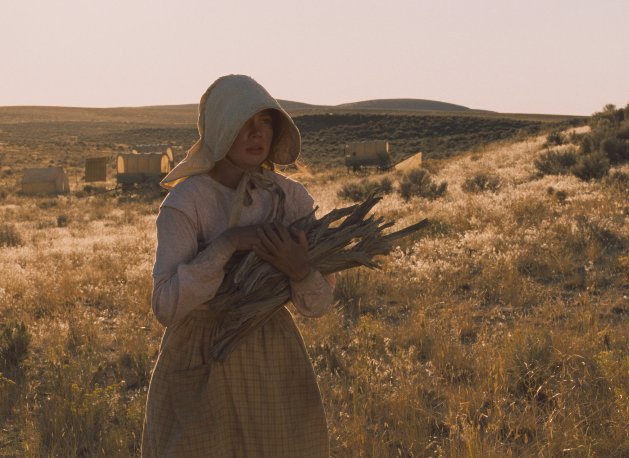
MEEK'S CUTOFF
Meek's Cutoff
Kelly Reichardt, 2010, USA, 104m
In 1845, three families hire the wild-eyed, bushy-bearded Meek (Bruce Greenwood) to lead them over Oregon's Cascade Mountains. Trekking through parched lands and running dangerously low on water, the group begins to lose faith in their tall-tale-telling guide, further questioning his instincts when they encounter a Native American wanderer. Like her earlier, incomparable Pacific Northwest-set films Old Joy (ND/NF 2006) and Wendy and Lucy (NYFF 2008), Kelly Reichardt's sublime Western explores American myths, precarious safety nets, and the kindness-and cruelty-of strangers. Magnificently shot by Chris Blauvelt, Meek's Cutoff reteams this essential director with deft screenwriter Jon Raymond and Wendy and Lucy star Michelle Williams, perhaps the toughest young bride in a calico dress you'll ever see.
My Joy/Schastye moe
Sergei Loznitsa, 2010, Ukraine/Germany/Netherlands, 127m
A most impressive feature debut, My Joy starts as the tale of Georgy, a driver who heads off from his home town with a truckload of goods for the market. A wrong turn leads him onto the back roads of the region and seemingly deeper into the area's hidden history. Weaving together several stories, Sergei Loznitsa creates an unsettling portrait of a world deceptively tranquil in appearance but harboring long festering resentments and violence that can surface without warning. The film beautifully moves between two modes-one decidedly contemporary, the other more historical or even mythic, as if these characters are always part of a larger, obscured reality of which they themselves are scarcely aware. My Joy is an encouraging example of the terrific work beginning to emerge again from the nations of the former Soviet Union.
Mysteries of Lisbon/Mistérios de Lisboa
Raúl Ruiz, 2010, Portugal/France, 272m
In 19th century Lisbon, a teenage boy raised by priests learns the secret of his aristocratic lineage; a French heiress (Clotilde Hesme) seeks revenge against the man who sullied her honor; and a kindly padre changes identities as it suits the occasion. These are among the characters who populate Raul Ruiz's breathtaking adaptation of one of the masterworks of Portuguese literature: Camilo Castelo Branco's Mysteries of Lisbon. Nothing-and nobody-is first as it/he appears in this intoxicating spiral of stories within stories within stories, filmed by Ruiz with gorgeous period design, a fluid, pirouetting camera, and a peerless French and Portuguese cast. A companion film to his magnificent Proust adaptation, Time Regained (NYFF 1999), Mysteries of Lisbon is the crowning achievement of a great director's career.
Of Gods and Men/Des hommes et des dieux
Xavier Beauvois, 2010, France, 120m
In this year's winner of the Grand Jury Prize at Cannes, director Xavier Beauvois recounts the harrowing true story of a brotherhood of French monks in the highlands of North Africa who find themselves threatened by Islamic extremists during the Algerian Civil War of the 1990s. Starring a gifted ensemble cast led by the empathic Lambert Wilson (as resident religious scholar Brother Christian), the film begins as a bucolic chronicle of these simple men of God and their gentle relationship with their Muslim neighbors, to whom they provide much needed medical care and other services. When the insurgents arrive, they find themselves faced with an impossible decision: to flee, or to stand their ground and fulfill their spiritual mission. Magnificently photographed by cinematographer Caroline Champetier in compositions that suggest Renaissance paintings, Of Gods and Men is a poetic, austerely beautiful triumph.
Oki's Movie/Ok hui ui yeonghwa
Hong Sang-soo, 2010, South Korea, 80m
NYFF perennial Hong Sang-soo's latest may be his wittiest-and his most deeply felt-work to date. Toggling between the present and the past, reality and fiction, and divided into four chapters (and different points of view), Oki's Movie recounts the amorous and artistic adventures of talented young director Jin-gu (Lee Sun-kyun), his middle-aged cinema instructor, Professor Song (Moon Sung-keun), and Oki (Jung Yumi), the woman who loves them both. As "Pomp and Circumstance" wryly plays throughout, the protagonists nobly fumble their way through romance and work, culminating in Jin-gu's disastrous post-screening Q&A. Hong's eleventh feature is a comedy with tremendous emotional heft, concluding with a heartbreaking précis on the vagaries of the heart and the terrors of aging.
Old Cats/Gatos viejos
Sebastián Silva, 2010, Chile, 88m
With last year's The Maid (ND/NF 2009) and now with Old Cats, Sebastián Silva has emerged as one of cinema's greatest young talents, mining the hilarity and horror of the nuclear family. Claudia Celedón and Catalina Saavedra-who, respectively, played la señora and the titular domestic servant in The Maid-star as girlfriends Rosario and Hugo, hapless schemers always borrowing money from Isadora and Enrique, Rosario's ailing mother and stepfather. When Isadora refuses to be swindled once again by her daughter, Rosario erupts in tears and recriminations, her hysterics setting off several outrageously funny scenes. A master of tone shifts, Silva seamlessly transforms his family farce into a weightier look at the responsibilities that parents and their offspring alike must face. World premiere.
Poetry/Shi
Lee Chang-dong, 2010, South Korea, 139m
As he did in his last film, Secret Sunshine (NYFF 2007), Lee Chang-dong creates another masterful tale about a woman raising a child on her own. Mija (played by the extraordinary Yoon Jeong-hee), a proper, sixtyish home aide in the early stages of dementia, lives with her sullen adolescent grandson, whose mother is looking for work in Pusan. Enrolling in a poetry class, Mija anxiously awaits inspiration from the muses-which arrives the moment she decides her charge must finally suffer the consequences of a heinous act he has committed. Perfectly paced and performed, Poetry stands out as both a quietly scathing condemnation of male violence (and the craven attempts to cover it up) and an ode to the strength-and moral compass-of an indefatigable senescent woman. A Kino International release.
Post Mortem
Pablo Larraín, 2010, Chile/Mexico/Germany, 98m
A literal and figurative dissection of his country's turbulent contemporary history, Chilean director Pablo Larraín's third feature is another highly original, darkly comic mix of the personal and the political from the director of Tony Manero (NYFF 2008). Set in 1973 in the last days of Salvador Allende's presidency, the film stars Tony Manero lead Alfredo Castro (here sporting a mane of long, whitish-blond hair) as Mario, an autopsy recorder who frequents a seedy burlesque hall where his neighbor, Nancy, is one of the dancers. Infatuated from afar, he finally works up the courage to visit her dressing room, and finds his affections if not exactly returned, at least entertained. As Mario haphazardly tries to woo Nancy away from her Popular Front boyfriend, Chile descends into chaos around them, until Mario finds himself an unwitting first-person witness to the grim face of violent social change.
Le Quattro Volte
Michelangelo Frammartino, 2010, Italy/Germany/France, 88m
Michelangelo Frammartino's wondrous four-part meditation on man and nature traces the grand cycle of life through the humble daily rituals of rural folk in the hilly southern Italian region of Calabria. An elderly shepherd ingests the dust from a church floor to treat his cough; a baby goat from his flock tentatively ventures out to pasture; a majestic fir tree is felled and repurposed as the centerpiece of a village celebration; finally, its logs are transformed into wood charcoal through the ancient methods of the local workers. Connecting the dots among animal, vegetable, mineral and dust, Frammartino's film is both concrete and cosmic, and it features what may be the most impressive single shot of the year: a masterfully orchestrated long take involving a religious procession, a herd of goats, a runaway truck, and a truly awe-inspiring dog.
Revolution/Revolución
Mariana Chenillo, Patricia Riggen, Fernando Eimbcke, Amat Escalante, Gael García Bernal, Rodrigo García, Diego Luna, Gerardo Naranjo, Rodrigo Plá and Carlos Reygadas, 2010, Mexico, 105m
The first major political revolution of the twentieth century, the Mexican Revolution transformed that society while offering a model for the rest of Latin America for government-directed social change. To commemorate its centenary, ten of Mexico's brightest young directors each contributed a short to this omnibus project, organized and co-produced by Gael Garcia Bernal and Diego Luna. Ranging from Patricia Riggen's delightful Beautiful and Beloved to Carlos Reygadas' explosive This is My Kingdom, Revolución is an intriguing collection of responses to the Revolution's legacy, a fascinating panorama of views on contemporary Mexico, as well as a terrific introduction to one of the world's most consistently exciting national cinemas.
The Robber/Der Räuber
Benjamin Heisenberg, 2010, Austria/Germany, 96m
Adapted from a novel that was in turn based on the real-life case of a champion marathoner who led a double life holding up banks in 1980s Austria, Benjamin Heisenberg's sleek and intelligent genre exercise is at once an action thriller, a love story, a character study, and an existential parable. Its protagonist, Johann (Andreas Lust, last seen here in the Oscar-nominated Revanche), is defined almost exclusively by his twin obsessions. He runs and he robs, therefore he is. Alternating between endorphin-rush kineticism and stretches of quiet tension, The Robber is as precise and single-minded as its hero. At the film's center is a brilliantly calibrated performance by Lust, by turns explosively physical and tightly coiled, as a man driven to attain a state of perpetual motion. (FYI, though having nothing to do with this film, Benjamin Heisenberg is the grandson of Werner Heisenberg, one of the founders of quantum physics.)

Patrick Keiller, 2010, UK, 101m
The British filmmaker Patrick Keiller is a master of the personal cine-essay and the political landscape film. As in his previous psycho-geographic tours London (1994) and Robinson in Space (1997), this new work purports to be constructed from footage recorded by Keiller's fictional alter-ego, the peripatetic researcher Robinson. Striking images of nature and marginal sites (military bases, opium fields, lichen growing on a traffic sign) are paired with the measured tones of a narrator (Vanessa Redgrave) who recounts Robinson's progress through the south of England and pieces together his notebook of musings on, among many other subjects, agriculture, architecture, the collapse of late capitalism and the extinction of the planet. Packed with secret histories, hidden connections, and a few whimsical fictions, Robinson in Ruins is a work of towering ambition and sly humor, densely informative but never dry, slicing through space and time with wit, alacrity, and eccentric intelligence.
Silent Souls/Ovsyanki
Aleksei Fedrochenko, 2010, Russia, 75m
Ancient customs and traditions live on in the wake of the former Soviet Union in Silent Souls, yet another bracing sign of life for serious filmmaking in the now-fragmented land. A brooding, poetic, hauntingly beautiful art film of the old school, albeit shot through with a modern frankness about society and sex, this short feature from Ukranian director Aleksei Fedorchenko centers on a unique sort of road trip. Imposing tough guy Miron requests that taciturn writer Aist accompany him on a long journey to dispose of the remains of his wife, whose body they transport in the back of the car. As they traverse the evocatively bleak landscape, Miron, according to custom, fills the hours relating the most intimate details of his relationship with his wife, leading to a surprising finale. Drenched in melancholy and haunted by an inescapable past, this is an exquisite work by a quickly rising director.
The Strange Case of Angelica/O Estranho Caso de Angélica
Manoel de Oliveira, 2010, Portugal/Spain/France/Brazil, 94m
More than ever a force of nature, the Portuguese master Manoel de Oliveira, 102 this December, delivers one of his most magical films: a radiant ghost story in which a dead newlywed comes to life before a camera lens. As the photographer hero (Ricardo Trepa) grows obsessed with this spectral beauty, the film evolves into an enchanting tale of cinema itself, intimately concerned with the act of perception and the conjuring of alternate worlds. Meditative and serene, with Chopin-scored passages of rapt contemplation and intense melancholy, Angelica is also unpredictably alive, filled with playful detours into subjects like particle physics, manual and mechanized labor, climate change, witchcraft, and the metaphysics of photography. This singular masterpiece could only be the work of an artist liberated by age: a man of multiple times, working with the freedom of a filmmaker almost as old as his medium. A Cinema Guild release.
Tuesday, After Christmas/Marti, dupa raciun
Radu Muntean, 2010, Romania, 99m
Paul (Mimi Branescu) must choose between his wife of ten years, Adriana (Mirela Oprisor), and his mistress, pediatric dentist Raluca (Maria Popistasu). Radu Muntean's singular, stripped-down look at adultery contains several masterfully composed long takes-scenes that further heighten the film's unbearable suspense, from the highly awkward meeting of all the players in the triangle to Paul's confession to his spouse. Muntean's trio of exemplary actors convey the raw emotional states of their characters without ever once relying on histrionics; though each performer is mesmerizing to watch, Oprisor, as the oblivious and then wounded wife, is astonishing in her portrayal of one woman's betrayal, hurt, and spite.
Uncle Boonmee Who Can Recall His Past Lives
Apichatpong Weerasethakul, 2010, UK/Thailand/France/Germany/Spain, 113m
Apichatpong Weerasethakul won the Palme d'Or at Cannes this year for this gently comic and wholly transporting tale of death and rebirth, set in Thailand's rural northeast. Uncle Boonmee, a farmer suffering from kidney failure, is tended to by loved ones and visited by the ghosts of his wife and son. As for his remembered past lives, they might-or might not-include a water buffalo, a disfigured princess, a talking catfish, and the insects whose chirps engulf the nighttime jungle scenes. A sensory immersion, Uncle Boonmee is an otherworldly fable that lingers on earthly sensations, a film about a dying man that's filled with mysterious signs of life. Apichatpong's vision is above all a generous one: in the threat of extinction he sees the possibility of regeneration. A Strand release.
We Are What We Are/Somos lo que hay
Jorge Michel Grau, 2010, Mexico, 99m
The sudden death of its patriarch leaves a Mexican clan bereft, panicked about their survival, and fumbling to continue a family tradition-namely, a cannibalistic rite that involves the hunting and gathering of fresh human meat in present-day Mexico City. As the widow and her three teenage children grow increasingly desperate, the young director Jorge Michel Grau combines slow-burning suspense with simmering sexual tension and a queasy sense of mystery: the belief system behind what the family calls "the ritual" is never fully explained. A potent and tremendously assured first feature, We Are What We Are packs the allegorical and visceral punch of the best vintage horror. An IFC Films release.
212 875 5601.
Labels: 48 New York Film Festival, Charles Ferguson, Clint Eastwood, David Fincher, Jean-Luc Godard, Julie Taymor, M Kelly Reichardt, Matt Damon, Michael Epstein, Mike Leigh, NYFF 2010, Richard Peña


